Worms & malwareIncident report
The Morris worm: how the internet's first big outage was patched overnight
A 1988 worm meant to measure the internet slowed thousands of machines instead; volunteers took it apart and patched it within days.
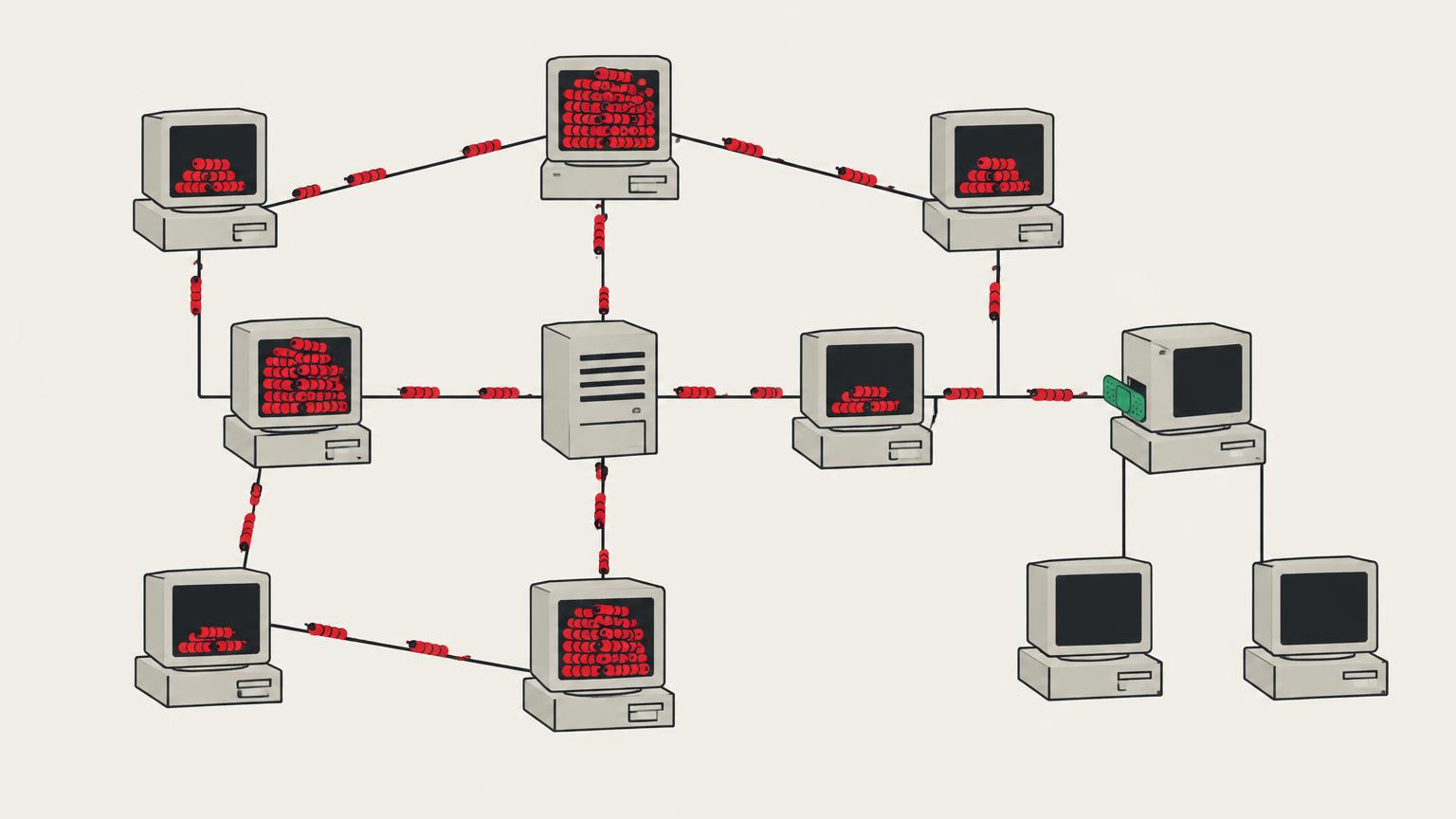
On the evening of 2 November 1988 a self-copying program spread across the young internet and, within hours, slowed thousands of university and research computers to a crawl. It was the first worm to cause widespread disruption on the internet, and its author said he had never meant it to do damage. Programmers at Berkeley, MIT and Purdue took it apart overnight, and patches for the holes it used were circulating within about two days.
When: November 1988 Hit: An estimated 6,000 computers, around a tenth of the internet at the time Way in: A debug mode in sendmail, a buffer overflow in fingerd, and trusted logins and weak passwords Found by: System administrators at universities and labs, as their machines ground to a halt Fixed by: Patches to sendmail and fingerd, shared by Berkeley and others over the network Time to fix: About two days to patches; a week to clean up most sites
What happened
In 1988 the internet linked roughly 60,000 computers, mostly at universities, government labs and research companies. People trusted each other, and many machines were configured to trust each other too.
Robert Tappan Morris, a 23-year-old graduate student at Cornell University, wrote a program meant to copy itself from computer to computer and, he later said, to measure how big the internet was. He released it from a computer at MIT on the evening of 2 November.
A flaw in its design turned the experiment into an outage. The worm copied itself far more often than it needed to, so infected machines filled up with copies of it, each using processor time, until they became too slow to use. Administrators unplugged their networks to stop it spreading, which also cut them off from the warnings and fixes travelling by email. The US Government Accountability Office later reported estimates that about 6,000 computers were infected and that the cost of the disruption ran from $100,000 to over $10 million.
How it worked
The worm used three different ways in, so that closing one was not enough.
The first was sendmail, the program that delivered email on most Unix systems. Many copies had been shipped with a debugging feature left switched on, which let a remote machine send commands instead of a message.
The second was fingerd, a small service that answered questions about who was logged in. It read requests into a fixed-size space in memory without checking their length. A request that was too long overwrote memory next to it, and the worm used that to make the program run its own instructions. This is a buffer overflow, and it was one of the first to be used at scale.
The third was trust between machines. Many Unix systems let users log in to a "trusted" neighbouring computer without a password, and many accounts had passwords that were easy to guess. The worm tried a list of common passwords and used trusted connections to move on.
Before copying itself onto a machine, the worm asked whether a copy was already running there. To stop administrators from fooling it with a fake "yes", it was written to install itself anyway about one time in seven. That one choice is why it multiplied out of control instead of spreading quietly.
How it was discovered
Nobody had to go looking for the worm. Within hours of its release, administrators at universities including Berkeley, MIT and Stanford saw their machines slowing down, their process lists full of unfamiliar programs and their systems running out of memory. Killing the processes did not help, because new copies arrived from the network.
Through the night, groups at Berkeley and MIT captured copies of the program and began taking it apart. They worked out which services it attacked by reading its decompiled code and watching what it did on isolated machines.
Researchers shared what they learned on a mailing list set up for the outbreak and on newsgroups, even though many sites had disconnected and could not read them. Eugene Spafford at Purdue wrote one of the first detailed analyses of the worm within weeks, and an MIT team published another, "With Microscope and Tweezers". Those reports confirmed exactly how it spread and what it did and did not do: it destroyed no files and stole no data.
The timeline
1988-11-02 · The worm is released from MIT
It spreads through the evening, and by late night administrators across the US see their machines slowing down.
1988-11-03 · Berkeley and MIT take it apart
Teams decompile captured copies and identify the sendmail and fingerd attacks. Warnings and a first fix for sendmail go out over the network.
1988-11-04 · Patches for sendmail and fingerd circulate
With both holes understood, administrators patch, change weak passwords and reconnect. New infections stop.
How it was fixed
The fix had three parts. Sendmail's debug mode was disabled. Fingerd was changed to check the length of what it read, closing the buffer overflow. Administrators reviewed which machines trusted each other and changed weak passwords. Some also used simple tricks the analysts found, such as creating a file the worm checked for, to stop it running while they patched.
Cleanup took longer than the fix. Every infected machine had to be found, cleared and patched before it was reconnected, and sites that had cut themselves off only learned about the fixes when they came back online. Most were running normally again within about a week.
What changed after
The worm showed that the internet had no one to call in an emergency. Within days, DARPA set up the Computer Emergency Response Team Coordination Center (CERT/CC) at Carnegie Mellon University in Pittsburgh to coordinate responses to future incidents, the first of many such teams around the world.
It also became a legal milestone. Morris was charged under the Computer Fraud and Abuse Act of 1986 and convicted in 1990, the first person convicted under that law. He was sentenced to three years' probation, 400 hours of community service and a fine of $10,050.
And it made buffer overflows, default settings and password strength core subjects of computer security, where they have stayed.
Lessons that still apply
- Ship with debugging off. Sendmail's debug mode was a convenience that became a door. Features meant for developers should not be on in production.
- Check every length. The fingerd overflow was the same class of mistake that would later cause Heartbleed and countless other bugs.
- Don't trust by location. Machines that let neighbours in without a password let one infection become many. Every connection should prove who it is.
- Have a plan for when the network is down. Sites that disconnected could not receive the fix. Keep a way to get warnings and patches that does not depend on the thing under attack.
Sources
- The Internet Worm Program: An Analysis, Eugene H. Spafford, Purdue University, November 1988
- With Microscope and Tweezers: An Analysis of the Internet Virus of November 1988, Mark W. Eichin and Jon A. Rochlis, MIT, 1989
- Morris Worm, Federal Bureau of Investigation
- Computer Security: Virus Highlights Need for Improved Internet Management (IMTEC-89-57), US General Accounting Office, June 1989
The fix → Two patches and some better passwords, written overnight by the people whose machines it had stopped.
